


2.5 Plumbing Installation
Cold water is supplied directly from the mains via a communal water tank into your new home.
There is an isolation lever valve located at high level behind an access panel in a cupboard in the hallway as described in Section 2.1. This is the shut off valve that you use in the case of an emergency.
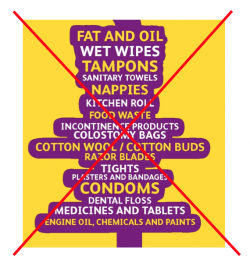
It is really important that everyone in your home is aware of the problems that can be caused by drain blockages. Seventy five percent of blockages in people’s drains and Thames Water sewers are caused by cooking fats, oil and grease (FOG) getting into the pipes. FOG gets into the pipes by people pouring it down sinks or toilets and from washing up fat and oil-soaked kitchen utensils or via dishwashers. The FOG solidifies over time and creates blockages. Blockages in household pipes can be particularly nasty, stopping waste water from leaving your home. If you find it difficult to flush your toilet or notice that water drains away slowly, this could be a sign of a blockage. When waste water is unable to flow away it can come back up from the toilet or sink, flooding your home.
Sewers are only designed to take away wastewater, toilet tissue and human waste. All other paper products, including kitchen roll and wet wipes, should be put in the bin. Wet wipes and sanitary items also contribute to some of the most troublesome blockages. Wipes do not break down like tissue, so may not get washed away down the pipe. When wipes mix with solids and fat, they set hard, forming a solid obstruction.
Even items that are marketed as ‘flushable’ or ‘biodegradable’ contribute to blockages. Although these items disappear when you flush your toilet, they do not break down in the sewers, as they take a number of years to disintegrate.
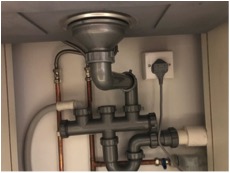
If a blockage occurs in the kitchen sink when it is full of water, try to remove the blockage by pushing a flexible rod down the plughole or by using a suction cup plunger to force water up and down the waste pipe. The sink has an overflow so the suction cup will work better if the overflow is blocked with a damp rag.
If this does not work, empty the sink by hand and try using a proprietary cleaner designed for blocked drains. Give the product time to work and try several times if necessary. Then try using the suction cup again.
If there is a blockage in the U-bend this can easily be disconnected and cleaned. Please make sure to put a bowl under the U-bend before you disconnect it to catch any waste water still in the sinks and pipes.
The waste pipe from the kitchen sink is exposed and accessible from the base unit below it. To access the U-bend it will be necessary to lift out and remove the shelf above the eco-bin. It is not necessary to remove the bin itself.
Kitchen Sink U-Bend and Pipework
Blockages in the bathroom are normally caused by a build-up of hair and soap and become noticeable when water drains away more slowly. You can try to remove the obstruction by using a “sani snake” (available from hardware stores) or by using a proprietary cleaner. Always follow the manufacturer’s instructions carefully. To help prevent blockages you can purchase a small filter to put over the bath/water outlet.
In the bathroom and en-suites the vanity units have a U-bend that can be accessed by pulling the draw out fully and then removing it which will allow easy access to the U-bend in the case of a blockage.
Bath panels are secured in place by hidden fixings. To access the waste pipe beneath the bath hold the bath panel firmly at the bottom with two hands and lift upwards to release it from the clips holding it in place. The panel will fall forward and can be lifted off and put to one side.
Reverse the operation to re-fit the bath panel once the matter has been investigated.
The timber framework behind the bath panel is sealed with waterproof mastic sealant but there is no need to re-seal the bath panel itself.
Bath Panel Removal, U-Bend and Pipework


The wall mounted WC has a concealed cistern that is housed behind the tiles. If there is a problem with the flush mechanism, then the flush plate can be removed in order to get access to the working parts. It is not necessary to remove any of the tiles to gain access to this.
To remove the flush plate hold the plate securely at the bottom and gently push it upwards to release it from the holding mechanism. Then pull the flush plate towards you and remove.


